Shopping Cart
There are no more items in your cart
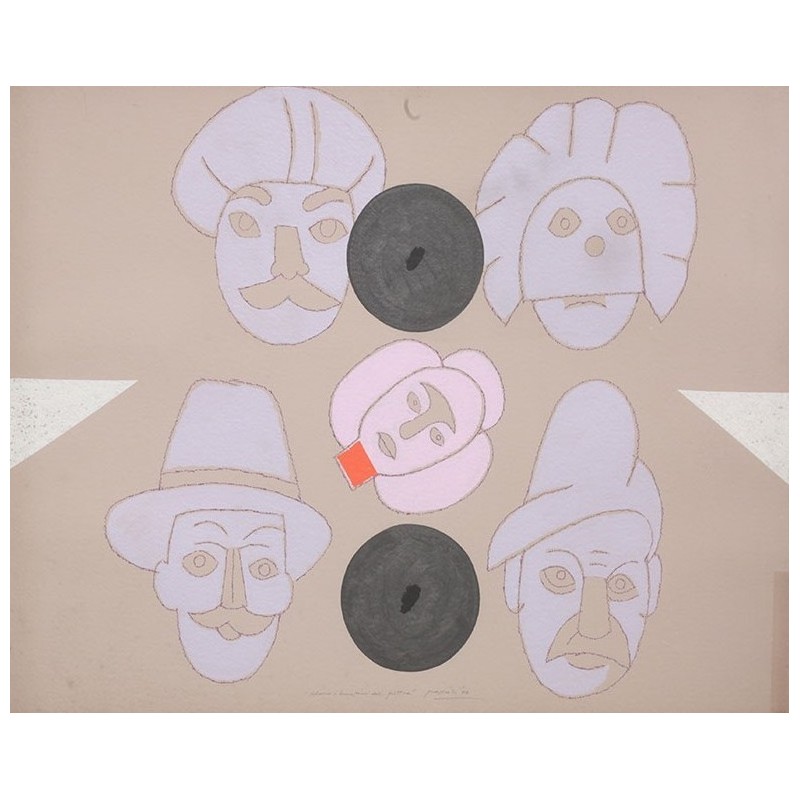
- New

Concetto Pozzati (Vò di Padova, Italy, 1935 — Bologna, Italy, 2017).
A leading figure of Nouvelle Figuration in the second half of the 1950s, Concetto Pozzati subsequently became one of the major exponents of Italian and European Pop Art. From the 1960s onwards, his visual language—defined by continuous blends, contaminations, and cultural intersections—became increasingly individual and recognizable. Pozzati’s approach remained consistently critical and biting; his work demands a "slow reading" that intentionally triggers intrigue and questioning. He is renowned for his pictorial cycles, most notably "Torture" (2004), in which the artist himself declared that the time for irony and desecration had passed, making way for a time of tragedy, and "De-Posizioni" (2006), in which he places a "body" within an unusual space—an "other" place—arranging it in different "positions" as if to remove all sense of theatricality. Throughout his career, he participated in major international exhibitions, including the Venice Biennale (1964, 1972, 1982, 2007), the São Paulo Art Biennial in 1963, the Tokyo Biennial in 1963 and 1994, documenta in Kassel in 1964, and the Paris Biennale in 1969, as well as major Italian exhibitions held in Mexico City, Vienna, Barcelona, Chicago, Paris, London, Kyoto, Frankfurt, Berlin, and Marseille.